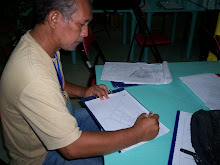
Exactly one year ago (March 1-4, 2010) in Guadalajara, Mexico, the author made that very memorable launching of a “3-day HUNGER STRIKE” in that: 10th UN FAO Agriculture Bio-technology Conference for Developing Countries (ABDC-10). It was attended by more than 300 people representing 63 countries, international funding institutions, multi-national seeds companies, NGOs and POs. The hunger strike was staged in order to protest imposition of Genetically Modified Organisms (GMO's) through the bureaucracies of third world countires using the platform of UNFAO. Although I did it alone, I represented the whole organization of the Asian Farmers Alliance that is why I considered it one of the best and challenging experiences I ever had in my life in the struggle for farmers’ empowerment.
Showing posts with label advocacy. Show all posts
10 March 2011
09 March 2011
Hunger Strike at the 10th UNFAO ABDC Conference (2)
Day 1 – Official Plenary Intervention of AFA
I am Isidore Ancog, farmer from Bohol Islands, Philippines. I am a tenant of a one hectare land, and I plant rice, peanuts, pineapple, vegetables, banana, yam and raise chicken, ducks and fish. I represent the Asian Farmers Alliance for Sustainable Rural Development or AFA. My organization in the Philippines is PAKISAMA, a national confederation of small farmers, marginal fishers, rural women, indigenous peoples and rural youth. My organization PAKISAMA is a member of AFA.
I am grateful and honored to be invited to this conference, and for that I thank wholeheartedly the organizers and FAO.
Before I came here I have two FEARS and suddenly it became three now. I had a chance to read some of the documents that pertains to this conference. But I sadly regret that some or most of the terms there I do not understand because it is written in modern scientific parlance. That is my first FEAR, to go home after this conference with less understanding of modern scientific jargons.
My second FEAR is centered on the title of this plenary; “Targeting biotechnologies to the poor”. I observe that the small scale men and women farmers and fishers, who form the majority of the poor in this world, are so underrepresented in this room. As a poor farmer in a remote province of Bohol, Philippines, I am extremely threatened rather than happy. This is a manifestation of what is happening in our villages – we are targeted, we are not involved in the process. Technologies are so top-down, imposed on us with very few knowledge given, especially on their limitations and effects.
However, there is one very obvious to me that I noticed. Most of the documents I came across are dealing with genetic engineering, and for that I have this feeling that this conference has defined biotechnology to zero-in towards massive commercialization of Genetically Modified Organisms. That is my third and biggest FEAR – to face defensively to an adverse intellectual arrogance on big scale?
As an organic farmer, I am against GMO; my province Bohol publicly rejects GMO, by law; my organization PAKISAMA –AFA fights against GMO. Why? Because we firmly believe it is not the solution to poverty and hunger, but rather a cause of more deprivation in the future. GMO’s doesn’t allow us to freely use, discover and exchange seeds. GMOs will not allow us to own seeds. It is seed control of big agri companies. It stops us from developing, discovering new seeds and technologies for our own. It is very clear that GMO is an attack to life; it is an insult to the most ancient culture, which is agriculture; it runs against ecology; it violates the law of nature and above all, it is disrespect to the integrity of creation.
We adhere to the biotecyhnology that is: ecologically sound, economically viable, socially just, culturally sensitive, technologically appropriate, scientifically holistic, and promotes total human development. For example, we use marcotting, grafting, NFTS fermentation; and these have helped us. BUT WE ARE SRONGLY AGAINST GENETIC ENGINEERING AND GMO’s.
I am Isidore Ancog, farmer from Bohol Islands, Philippines. I am a tenant of a one hectare land, and I plant rice, peanuts, pineapple, vegetables, banana, yam and raise chicken, ducks and fish. I represent the Asian Farmers Alliance for Sustainable Rural Development or AFA. My organization in the Philippines is PAKISAMA, a national confederation of small farmers, marginal fishers, rural women, indigenous peoples and rural youth. My organization PAKISAMA is a member of AFA.
I am grateful and honored to be invited to this conference, and for that I thank wholeheartedly the organizers and FAO.
Before I came here I have two FEARS and suddenly it became three now. I had a chance to read some of the documents that pertains to this conference. But I sadly regret that some or most of the terms there I do not understand because it is written in modern scientific parlance. That is my first FEAR, to go home after this conference with less understanding of modern scientific jargons.
My second FEAR is centered on the title of this plenary; “Targeting biotechnologies to the poor”. I observe that the small scale men and women farmers and fishers, who form the majority of the poor in this world, are so underrepresented in this room. As a poor farmer in a remote province of Bohol, Philippines, I am extremely threatened rather than happy. This is a manifestation of what is happening in our villages – we are targeted, we are not involved in the process. Technologies are so top-down, imposed on us with very few knowledge given, especially on their limitations and effects.
However, there is one very obvious to me that I noticed. Most of the documents I came across are dealing with genetic engineering, and for that I have this feeling that this conference has defined biotechnology to zero-in towards massive commercialization of Genetically Modified Organisms. That is my third and biggest FEAR – to face defensively to an adverse intellectual arrogance on big scale?
As an organic farmer, I am against GMO; my province Bohol publicly rejects GMO, by law; my organization PAKISAMA –AFA fights against GMO. Why? Because we firmly believe it is not the solution to poverty and hunger, but rather a cause of more deprivation in the future. GMO’s doesn’t allow us to freely use, discover and exchange seeds. GMOs will not allow us to own seeds. It is seed control of big agri companies. It stops us from developing, discovering new seeds and technologies for our own. It is very clear that GMO is an attack to life; it is an insult to the most ancient culture, which is agriculture; it runs against ecology; it violates the law of nature and above all, it is disrespect to the integrity of creation.
We adhere to the biotecyhnology that is: ecologically sound, economically viable, socially just, culturally sensitive, technologically appropriate, scientifically holistic, and promotes total human development. For example, we use marcotting, grafting, NFTS fermentation; and these have helped us. BUT WE ARE SRONGLY AGAINST GENETIC ENGINEERING AND GMO’s.
Hunger Strike at the 10th UNFAO ABDC Conference (3)
Day 2 – Official Plenary Intervention of AFA
I am Isidore Ancog from AFA.
As I said at the start of this conference, I came here with three fears, and much as I like that this conference responds to my fears.
As in the past, modern technologies came and went in our small farmlands especially that of green revolution; some died early, some stayed longer, but just the same those did not sustain. Why because we don’t own those technologies. Those were imposed on us from the top. As usual technicians from either public or private sector, come to our farms and introduce new inventions, and when failed they just disappear, leaving us cleaning their mess – sometimes it will take years. We do not even know the scientists who invented those technologies to let them hold accountable.
Technicians can live without our farms, but we cannot. Farming is not only our means of living – but it is our way of life.
If you want your technologies to be accepted by small fishers, be transparent. Allow us to participate in the process and do not name it by yourself or your company. After all, if you insist for an IPR of your inventions, we can always insist not to use our farms as testing grounds. And that also applies to Seeds.
For us Seeds are nature’s gift for the use of everybody freely without restrictions. By any moral tradition, no one has the exclusive right to own them and deprived freedom of others to use them. For us any law that legalizes it is therefore immoral and malicious.
As this conference go, it seems to me that there is no holding back for genetic engineering technologies to be in our individual farmlands anytime soon. This time, I just hope that we will be approached by technicians who are transparent with their sources as well as their motives. I hope they knock our doors.
Pardon me for repeating what I have said yesterday, that “I am extremely threatened, not happy”. And I am saying that in the name of PAKISAMA in the Philippines and AFA in Asia.
I have high respect to all the people attending this conference. But yet, I am formally announcing that I am on a HUNFGER STRIKE beginning this lunchtime. This is to signify our protest against GMOs.
Finally, as a recognize participant in this conference, I invoke my right to ask that this statement and my statement yesterday be included in the document and proceedings thereafter; thank you very much.
Hunger Strike at the 10th UNFAO ABDC Conference (4)
Day 4 – Official Plenary Intervention of AFA
I am Isidore Ancog, farmer from the Philippines.
I would like again to express my deepest thanks to the organizers and to FAO for inviting me here. It is unusual for us farmers to be invited to a conference like this, and be accorded the space tosay what I have to say.
But the conference report did not even express the points I raised in this conference. I am a farmer, representing a regional federation of farmers, fisherfolks, rural women and indigenous peoples that compose Asian Farmers Alliance. I expressed that biotechnologies particularly GMOs are being imposed on us farmers, right now in our farms. And that GMOs have negative impacts on our livelihoods as small holder farmers and organic agriculture practitioners. GMOs do not allow us to take control of our own resources. It fails to recognize our capacities to innovate. It is an insult to our way of life.
Beyond these walls, poverty and hunger still exist. Beyond these walls, peasant farmers, fisherfolk, rural women and indigenous peoples continue to be neglected and ignored in decision making processes and technology development processes. I am calling on delegates and FAO to address this gap. This conference and my invitation to this conference is a good start, but it is not enough. There is but a few farmers here. I propose, that FAO convene an international meeting of peasants farmers, fisherfolks, rural women, livestock keepers, pastoralists, and indigenous peoples, to discuss about the results of this conference, the implications of biotechnology, particularly GMOs in our lives and allow us to decide for ourselves the courses of actions to take.
With this, I formally lift my hunger strike. But rest assured that we will continue with our advocacy and vow to produce healthy and safe food in our fields, which we will all enjoy, as one people. Thank you very much.
I am Isidore Ancog, farmer from the Philippines.
I would like again to express my deepest thanks to the organizers and to FAO for inviting me here. It is unusual for us farmers to be invited to a conference like this, and be accorded the space tosay what I have to say.
But the conference report did not even express the points I raised in this conference. I am a farmer, representing a regional federation of farmers, fisherfolks, rural women and indigenous peoples that compose Asian Farmers Alliance. I expressed that biotechnologies particularly GMOs are being imposed on us farmers, right now in our farms. And that GMOs have negative impacts on our livelihoods as small holder farmers and organic agriculture practitioners. GMOs do not allow us to take control of our own resources. It fails to recognize our capacities to innovate. It is an insult to our way of life.
Beyond these walls, poverty and hunger still exist. Beyond these walls, peasant farmers, fisherfolk, rural women and indigenous peoples continue to be neglected and ignored in decision making processes and technology development processes. I am calling on delegates and FAO to address this gap. This conference and my invitation to this conference is a good start, but it is not enough. There is but a few farmers here. I propose, that FAO convene an international meeting of peasants farmers, fisherfolks, rural women, livestock keepers, pastoralists, and indigenous peoples, to discuss about the results of this conference, the implications of biotechnology, particularly GMOs in our lives and allow us to decide for ourselves the courses of actions to take.
With this, I formally lift my hunger strike. But rest assured that we will continue with our advocacy and vow to produce healthy and safe food in our fields, which we will all enjoy, as one people. Thank you very much.
06 March 2011
The Bohol Organic Agriculture Movement
Flashback to the Period of Abundance. Once upon a time, the province’s organic farming tradition was so pure and sacred. Rice being the staple food for Boholanos has been culturally implanted deeply into its way of life. Because of this, farmers’ myths and epics have not escaped the long stretch of the early artists’ imaginations so that those can be told from one generation to another over and over again. Boholano songs, dances, poetry and folklores speak eloquently of the richness of the early farming and fishing communities.
But then, in the 1960’s, the Green Revolution (GR) entered its way in the Philippines’ agriculture sector. As a result, the long-lived and best-kept farming traditions slowly vanished in the hearts of the Boholanos, giving way to the modern and “scientific” farming methods. With it, many traditional seeds were replaced by the ‘improved high yielding varieties’ (HYV’s) especially for rice. Mono cropping was introduced in the uplands along with its massive, conventional use of synthetic fertilizers and pesticides.
Spread of Green Revolution and Modern Agriculture. In the 70’s, governments’ agriculture programs were massive and forceful. Since the Philippines was under martial law at that time, government affairs cannot be questioned. Modern and scientific farming were the key words and the Green Revolution was the battle cry. In the middle of the 70’s, hundreds of Boholano young students flooded to agricultural schools like the Bohol Agricultural College (now CVSCAFT Systems Main Campus) in Bilar, because of the phenomenal promise of good future if one becomes an agriculturist. Some were privileged enough to enroll at Central Mindanao University (CMU) in Musuan, Bukidnon, or at Visayas State College of Agriculture (VISCA) in Leyte, or even UP in Los Baños. In the school, the language taught was modern and scientific farming.
High yielding varieties were introduced to the farmers’ field. This movement was very attractive causing the loss of many traditional seeds not only for rice but also for other crops such as corn, cassava and vegetables. Government programs made easy access of commercial fertilizers and certified seeds that eventually drowned the farmers into total dependence on external farm inputs. Amusingly, at first, farmers’ harvests doubled at once. Again, and again. .. until, the soils’ demand for chemical fertilizers grew higher. From one sack… to two sacks… to three and beyond…
Surprisingly, despite the seemingly attractive promise of GR that was strongly promoted by the government, Boholano farmers were driven towards debt and extreme poverty. Farmers were forced into a cycle of dependency on chemical fertilizers, pesticides and other expensive inputs which eroded soil fertility, damaged ground water and human health, and eventually decreased yields. Most farmlands became depleted and infertile worsened by the government’s total neglect of the environment. Farming conditions became problematic, almost totally losing its direction, and the farmers were unable to keep up with GR’s financial demand.
In the later part of the 70’s and the early 80’s, many traditional seeds were already lost not only for rice but also for other crops. Pests and diseases, such as armyworms and “tungro” which were non- existent before appeared, attacking crops in mass proportions. To combat such infestation, a multi-pronged program of hybrid seeds, pesticides, fungicides and herbicides flooded the market. Even a seven-year old kid can buy “parapest” or “thiodan” in ordinary stores. As government programs made it possible for commercial fertilizers, pesticides and certified seeds to be easily accessible, farmers eventually became totally dependent on these external farm inputs.
Realization, Conscientization and Sporadic Actions. In the 80’s, growing awareness and consciousness to revive traditional farming practices in Bohol was gaining momentum. It started with the Ilaw International Center (IIC), that introduced the household-based ‘bio-intensive gardening’ technology in 1982. Along with it was the formation of the “Ilaw ng Buhay Movement” in fifteen municipalities of the province. In 1984, IIC was responsible in providing environmental trainings on organic farming technologies, agro-forestry and coastal resource conservation to a group of government employees, who later on run a World Bank funded initiative called the Central Visayas Regional Project (CVRP). The CVRP likewise started the contour farming system and marine conservation initiatives in Bohol particularly in the north.
Almost in the same period, the Social Action Center (SAC) of the Diocese of Tagbilaran, in partnership with MASIPAG introduced contour farming, soil conservation and alternative medicine projects in the eastern part of the island particularly in the towns of Anda, Guindulman and Candijay, as a direct response to rehabilitate victims of typhoon “Nitang” which hit the northeastern part of the province in 1983.
On a parallel development, a Peace Corp Volunteer working for the Baptist Church in Candijay introduced “Food Always in the Home”, popularly known today by its acronym FAITH – a family-based organic vegetable raising initiative. Not so far away, in the town of Bilar, Mr. Jose Travero, a young fresh graduate and Entomology Professor of then Bohol Agricultural College (BAC), became the “voice in the wilderness” fighting an uphill battle and against all odds made possible for organic agriculture to be included into its schools’ curriculum.
In the later part of 1980’s, as an offshoot of the EDSA revolution (1986), NGO’s mushroomed and development work spread quickly. But sadly, not all of their programs were for organic farming. In fact, most NGO’s collaborated with government agriculture programs by providing loan assistance for farm inputs particularly commercial fertilizers and pesticides.
In 1987, Candijay Federation of Rural Workers (CFRW) was formed and initiated organic farming and compost fertilizer production in the town of Candijay. The group was organized by Candijay Service Center which later on in 1991 was registered as Community Awareness and Services for Ecological Concerns (CASEC), Inc. Two years later, the Visayas Community Assistance Program (VICAP), a Cebu-based NGO launched the Bohol Community Assistance Project (BOCAP) in Candijay and Guindulman. Its focused was also organic farming particularly contour farming and composting. Not long afterwards, BOCAP became an independent NGO working in Bohol until the present.
In 1989, the Department of Agriculture formally established the Farmers’ Training Center (FTC) in Bohol that served as its training arm. Although undeniably, DA was the prime initiator for GR technologies, organic farming was introduced in some of the Center’s training curricula particularly on vegetables’ bio-intensive gardening. Integrated Pest Management (IPM) then was already in the mainstream in response to the growing awareness against indiscriminate use of chemical pesticides. The Center later on stood as the Agricultural Training Institute (ATI) - 7, Central Visayas.
In this year also, the Diocese of Tagbilaran was split into two giving birth to the Diocese of Talibon which has the territorial/pastoral jurisdiction over the Northern and Eastern part of Bohol. Consequently, the SA initiatives in this part of the province were taken over by SAC-Talibon until at present. The famous “humay sa Obispo” (bishop’s rice) is a by-word of the farmers that meant to identify the organic rice seeds from Masipag being distributed by SAC for varietal adaptation in the parishes of Talibon some time in the middle of the 90’s.
Consolidation of Environment Conservation Initiatives. In the early part of 1990’s, while PROCESS Bohol was already very active in the formation of peoples’ organizations in the coastal communities, the Central Visayas Farmers’ Development Center (FARDEC), launched a comprehensive Cropline Research in Central Visayas that exposed concretely the deep-rooted issues and problems of small farmers in the region’s Agrarian Economy, including Bohol’s rice, corn, cassava, and coconut industries.
In 1991, about 13 NGO’s convened to form the Bohol Alliance of Non-government Organizations (BANGON), with the hope to consolidate and unite community development initiatives. BANGON created its own Secretariat and solidified resource mobilization which resulted in accessing various projects like the Local Development Assistance Project funded by Philippine Business for Social Progress (PBSP), and the five-year project, Loboc Area Focused Approach (Loboc-AFA), funded by AusAID through the PACAP. The project’s primary approach was community-based resource management and sustainable livelihoods including organic farming within the Loboc River Watershed.
In 1992, Bohol Integrated Development Foundation (BIDEF) initiated a project on Sustainable Agriculture in Dagohoy, covering eight barangays. Through that project, BIDEF opened Bohol’s civil society to the national limelight of NGO alliances and networks by becoming active member of three big national NGO networks; the NGO-Coalition for Cooperative Development (NGO-CCD), the Sibol ng Agham at Technolohiya (SIBAT), and later on Coalition of Developmental Non-government Organizations (CODE-NGO).
Permaculture was introduced in Bohol’s organic movement in 1993 through the effort of Carlos Echaves of Bol-anon Foundation Inc. (BFI). The BFI initiated series of orientations and trainings which was able to invite interest of several groups and individual advocates leading to the formation of the Permaculture Institute of the Philippines- Bohol.
Meanwhile, the growing interest on sustainable agriculture and environmental protection has led further to the formation of BISAD – an effort which was spearheaded by certain individuals, the likes of: Fr. Romeo Dompor - BIDEF, Ms. Liza Migriňo - OPA, Mr. Carlos Echaves - BF, Mr. Jose Travero - BAC, Mr. Egay Dy –CASEC, and many more. Its first election was on September 23, 1994 in Ubay, Bohol, with Mr. J. Travero as its first President. This initiative signaled the formalization of the organic agriculture movement in Bohol.
In the same year, three (3) research- oriented NGO’s entered the picture in Bohol’s conservation movement. Firstly, the Soil and Water Conservation Foundation (SWCF) which made its way to the highlands of Sierra Bullones to investigate Bohol’s water reserve and the condition of its watershed. Later on, SWCF happily communed with the Eskaya tribe, and began to crop organically in the tribe’s ancestral lands. Secondly, the Haribon Foundation in partnership with Montreal University rippled in Handayan Island’s coastal waters for a Project Seahorse Conservation. Decade after, Project Seahorse spun-off from Haribon Foundation and became an independent conservationist NGO called Project Seahorse Foundation, working along with the lantern fishers in the Danajon bank area. Thirdly, the CBDC-SEARICE (Community Biodiversity Development and Conservation-Southeast Asia Research Initiative for Community Empowerment), that started the plant genetic research in Bohol. Few years later, SEARICE settled in few communities in Dagohoy and Bilar for its community-based genetic biodiversity conservation, that resulted into the first ever community seeds registry in the Municipality of Bilar.
In the same period, the first ever non- conventional marketing assistance was provided to the banana growers in Bohol. Peoples’ Fair Trade Assistance Center (PFTAC) opened its operations and started the banana marketing business of chemical free banana directly to Japan. The marketing strategy provided opportunity to the banana producers to organize themselves and directly participate in the business and share of the profit – an exercise that never occurred in the conventional mainstream market. Years later PFTAC and OPA spearheaded the creation of the Bohol Banana Council.
In 1995, volunteers launched the Bohol UP Pahinungod in the Municipalities of Balilihan, Anda and Dauis. This was where a Farmer-Scientist program was implemented through the assistance of Dr. Romulo Davide and other UP professors. In this year also, Biodynamic Farming was introduced in the already growing organic movement in Bohol through two devoted Biodynamic Farming Practitioners; Ms. Zen Darunday and Mr. Salvio Makinano. Ms. Darunday owns the CEDAR Farm in Dao, while Mr. Makinano owns the UsaP ka Farm, in Tiptip, both in Taqbilaran City.
In 1997, a group of professionals, environment conservationist groups, NGO’s, church people and students bond together and called themselves the Bohol Nature Conservation Society (BONACONSO). It became one of the strongest environmental conservation group in Bohol. In fact, BONACONSO was deeply involved in the series of workshops and planning until it was finally passed into law the landmark legislation called the Bohol Environment Code. On July 26, 1997, BONACONSO and SAC-Talibon spearheaded the biggest environmental mass protests ever in Bohol that happened in the town of Inabanga. The protest rally was meant to block the controversial Bohol-Cebu Water Deal or the selling of water from Wahig-Inabanga River to Cebu City. Since then, the deal was never been talked about in public.
Towards the end of the 90’s, Organic Farming was already in the mainstream of Bohol’s development initiatives. Established NGO’s like PROCESS-Bohol, Feed the Children Philippines, World Vision, UBCDFI, among others, became known as organic agriculture implementers. It was also in this period that Mr. Ruben Balistoy, a former rebel opened and operated the Purple Life Farms (PLF) in Taloto, Tagbilaran City – the first ever organic free-range chicken farm in Bohol. Established in April 1999, PLF aimed at firming up the viability of the enterprise and sought to gain experience and achieve enough capability towards full commercial production .
Specifically, in 1999 BISAD was reactivated from a short period of lull, probably because everybody was busy doing each own and nobody cared for collectivity. Mr. Ruben Balistoy was elected the new President. This time it comprises more than forty members from various groups, such as: non-government organizations; local government line agencies; national government agencies; academic institutions; private/individual farm owners; peoples’ organizations; cooperatives; church-based organizations; etc.. On this period, BISAD started the organic marketing business (organic tabo); organic congresses, and the organic fertilizer (bokashi) production business in partnership with the City of Tagbilaran. They undertook various forms of advocacies and lobbying which included the eventual signing into law the landmark legislation GMO-Free ordinance.
From then on, BISAD become the legendary symbol and proof that organic agriculture movement is very much alive in the province of Bohol.
Organic Agriculture Mainstreaming. Towards year 2000, organic agriculture mainstreaming was already on its full swing. Major activities were launched which were spearheaded by BISAD in partnership with various institutions like the OPA, ATI, the Academe, SEARICE, PFTAC and several other interest groups and individuals.
• Ubi Festival was launched giving way to the birth of Bohol Ubi Center Foundation, Inc. (BUCFI). An annual ubi festival every January also became a regularly celebrated activity. Organic ubi growing became the main thrust in promoting ubi culture among ubi farmers in Bohol.
• SAC-Talibon in collaboration with MASIPAG started rice variety trials in 12 Parishes and succeeded in propagating, distribution and monitoring 25 traditional rice varieties to the parishioners.
• SEARICE, in partnership with CVSCAFT main campus, successfully pushed for the establishment of Bilar as the province’s “Rice Sanctuary”, and finally put into law and installed in the Municipality the Community Seed Registry. The Community Seedbank was also established and maintained at the CVSCAFT campus.
• Bohol Provincial LGU initiated SuOAP (Sustainable Organic Agriculture Program) which resulted to 4,600 households into backyard gardening in 5 municipalities and 33 barangays. In support for the program the province allocated P1M that resulted to the establishment of Municipal Organic Agriculture Programs; 223 organic farmers to a total of 171.6 hectares.
• ATI-7 consolidated its community-based initiatives by forming CASABUT-OFS - an organic farmers alliance in Maribojoc whose accomplishments became the subject of many study tours by studying farmers and organic practitioners. ATI-7 also initiated the “school-in-the-air” classes which gained popularity not only by farmers but also implementers.
• Development of the 33 standards Bohol Internal Guarantee System for organic product certification.
Challenges of the Organic Movement. For almost three decades, BISAD as a movement was always confronted with challenges big and small; some permanent, some temporary. To say the least, here are some of those urgent: 1) A cohesive group of NGOs, GOs, NGAs, POs promoting organic agriculture following the principles of Sustainable Agriculture; 2) A paradigm shift from technocratic to farmer-centered, knowledge development approach in implementing Sustainable Agriculture; 3) Mainstreaming of gender equity in the farming sector; 4) Rural Industrialization based on culturally and environmentally rooted livelihoods and modes of production; 4) Sustainable development anchored on deep respect for nature and clear understanding on the complexities of ecosystems and the balance of ecology.
But then, in the 1960’s, the Green Revolution (GR) entered its way in the Philippines’ agriculture sector. As a result, the long-lived and best-kept farming traditions slowly vanished in the hearts of the Boholanos, giving way to the modern and “scientific” farming methods. With it, many traditional seeds were replaced by the ‘improved high yielding varieties’ (HYV’s) especially for rice. Mono cropping was introduced in the uplands along with its massive, conventional use of synthetic fertilizers and pesticides.
Spread of Green Revolution and Modern Agriculture. In the 70’s, governments’ agriculture programs were massive and forceful. Since the Philippines was under martial law at that time, government affairs cannot be questioned. Modern and scientific farming were the key words and the Green Revolution was the battle cry. In the middle of the 70’s, hundreds of Boholano young students flooded to agricultural schools like the Bohol Agricultural College (now CVSCAFT Systems Main Campus) in Bilar, because of the phenomenal promise of good future if one becomes an agriculturist. Some were privileged enough to enroll at Central Mindanao University (CMU) in Musuan, Bukidnon, or at Visayas State College of Agriculture (VISCA) in Leyte, or even UP in Los Baños. In the school, the language taught was modern and scientific farming.
High yielding varieties were introduced to the farmers’ field. This movement was very attractive causing the loss of many traditional seeds not only for rice but also for other crops such as corn, cassava and vegetables. Government programs made easy access of commercial fertilizers and certified seeds that eventually drowned the farmers into total dependence on external farm inputs. Amusingly, at first, farmers’ harvests doubled at once. Again, and again. .. until, the soils’ demand for chemical fertilizers grew higher. From one sack… to two sacks… to three and beyond…
Surprisingly, despite the seemingly attractive promise of GR that was strongly promoted by the government, Boholano farmers were driven towards debt and extreme poverty. Farmers were forced into a cycle of dependency on chemical fertilizers, pesticides and other expensive inputs which eroded soil fertility, damaged ground water and human health, and eventually decreased yields. Most farmlands became depleted and infertile worsened by the government’s total neglect of the environment. Farming conditions became problematic, almost totally losing its direction, and the farmers were unable to keep up with GR’s financial demand.
In the later part of the 70’s and the early 80’s, many traditional seeds were already lost not only for rice but also for other crops. Pests and diseases, such as armyworms and “tungro” which were non- existent before appeared, attacking crops in mass proportions. To combat such infestation, a multi-pronged program of hybrid seeds, pesticides, fungicides and herbicides flooded the market. Even a seven-year old kid can buy “parapest” or “thiodan” in ordinary stores. As government programs made it possible for commercial fertilizers, pesticides and certified seeds to be easily accessible, farmers eventually became totally dependent on these external farm inputs.
Realization, Conscientization and Sporadic Actions. In the 80’s, growing awareness and consciousness to revive traditional farming practices in Bohol was gaining momentum. It started with the Ilaw International Center (IIC), that introduced the household-based ‘bio-intensive gardening’ technology in 1982. Along with it was the formation of the “Ilaw ng Buhay Movement” in fifteen municipalities of the province. In 1984, IIC was responsible in providing environmental trainings on organic farming technologies, agro-forestry and coastal resource conservation to a group of government employees, who later on run a World Bank funded initiative called the Central Visayas Regional Project (CVRP). The CVRP likewise started the contour farming system and marine conservation initiatives in Bohol particularly in the north.
Almost in the same period, the Social Action Center (SAC) of the Diocese of Tagbilaran, in partnership with MASIPAG introduced contour farming, soil conservation and alternative medicine projects in the eastern part of the island particularly in the towns of Anda, Guindulman and Candijay, as a direct response to rehabilitate victims of typhoon “Nitang” which hit the northeastern part of the province in 1983.
On a parallel development, a Peace Corp Volunteer working for the Baptist Church in Candijay introduced “Food Always in the Home”, popularly known today by its acronym FAITH – a family-based organic vegetable raising initiative. Not so far away, in the town of Bilar, Mr. Jose Travero, a young fresh graduate and Entomology Professor of then Bohol Agricultural College (BAC), became the “voice in the wilderness” fighting an uphill battle and against all odds made possible for organic agriculture to be included into its schools’ curriculum.
In the later part of 1980’s, as an offshoot of the EDSA revolution (1986), NGO’s mushroomed and development work spread quickly. But sadly, not all of their programs were for organic farming. In fact, most NGO’s collaborated with government agriculture programs by providing loan assistance for farm inputs particularly commercial fertilizers and pesticides.
In 1987, Candijay Federation of Rural Workers (CFRW) was formed and initiated organic farming and compost fertilizer production in the town of Candijay. The group was organized by Candijay Service Center which later on in 1991 was registered as Community Awareness and Services for Ecological Concerns (CASEC), Inc. Two years later, the Visayas Community Assistance Program (VICAP), a Cebu-based NGO launched the Bohol Community Assistance Project (BOCAP) in Candijay and Guindulman. Its focused was also organic farming particularly contour farming and composting. Not long afterwards, BOCAP became an independent NGO working in Bohol until the present.
In 1989, the Department of Agriculture formally established the Farmers’ Training Center (FTC) in Bohol that served as its training arm. Although undeniably, DA was the prime initiator for GR technologies, organic farming was introduced in some of the Center’s training curricula particularly on vegetables’ bio-intensive gardening. Integrated Pest Management (IPM) then was already in the mainstream in response to the growing awareness against indiscriminate use of chemical pesticides. The Center later on stood as the Agricultural Training Institute (ATI) - 7, Central Visayas.
In this year also, the Diocese of Tagbilaran was split into two giving birth to the Diocese of Talibon which has the territorial/pastoral jurisdiction over the Northern and Eastern part of Bohol. Consequently, the SA initiatives in this part of the province were taken over by SAC-Talibon until at present. The famous “humay sa Obispo” (bishop’s rice) is a by-word of the farmers that meant to identify the organic rice seeds from Masipag being distributed by SAC for varietal adaptation in the parishes of Talibon some time in the middle of the 90’s.
Consolidation of Environment Conservation Initiatives. In the early part of 1990’s, while PROCESS Bohol was already very active in the formation of peoples’ organizations in the coastal communities, the Central Visayas Farmers’ Development Center (FARDEC), launched a comprehensive Cropline Research in Central Visayas that exposed concretely the deep-rooted issues and problems of small farmers in the region’s Agrarian Economy, including Bohol’s rice, corn, cassava, and coconut industries.
In 1991, about 13 NGO’s convened to form the Bohol Alliance of Non-government Organizations (BANGON), with the hope to consolidate and unite community development initiatives. BANGON created its own Secretariat and solidified resource mobilization which resulted in accessing various projects like the Local Development Assistance Project funded by Philippine Business for Social Progress (PBSP), and the five-year project, Loboc Area Focused Approach (Loboc-AFA), funded by AusAID through the PACAP. The project’s primary approach was community-based resource management and sustainable livelihoods including organic farming within the Loboc River Watershed.
In 1992, Bohol Integrated Development Foundation (BIDEF) initiated a project on Sustainable Agriculture in Dagohoy, covering eight barangays. Through that project, BIDEF opened Bohol’s civil society to the national limelight of NGO alliances and networks by becoming active member of three big national NGO networks; the NGO-Coalition for Cooperative Development (NGO-CCD), the Sibol ng Agham at Technolohiya (SIBAT), and later on Coalition of Developmental Non-government Organizations (CODE-NGO).
Permaculture was introduced in Bohol’s organic movement in 1993 through the effort of Carlos Echaves of Bol-anon Foundation Inc. (BFI). The BFI initiated series of orientations and trainings which was able to invite interest of several groups and individual advocates leading to the formation of the Permaculture Institute of the Philippines- Bohol.
Meanwhile, the growing interest on sustainable agriculture and environmental protection has led further to the formation of BISAD – an effort which was spearheaded by certain individuals, the likes of: Fr. Romeo Dompor - BIDEF, Ms. Liza Migriňo - OPA, Mr. Carlos Echaves - BF, Mr. Jose Travero - BAC, Mr. Egay Dy –CASEC, and many more. Its first election was on September 23, 1994 in Ubay, Bohol, with Mr. J. Travero as its first President. This initiative signaled the formalization of the organic agriculture movement in Bohol.
In the same year, three (3) research- oriented NGO’s entered the picture in Bohol’s conservation movement. Firstly, the Soil and Water Conservation Foundation (SWCF) which made its way to the highlands of Sierra Bullones to investigate Bohol’s water reserve and the condition of its watershed. Later on, SWCF happily communed with the Eskaya tribe, and began to crop organically in the tribe’s ancestral lands. Secondly, the Haribon Foundation in partnership with Montreal University rippled in Handayan Island’s coastal waters for a Project Seahorse Conservation. Decade after, Project Seahorse spun-off from Haribon Foundation and became an independent conservationist NGO called Project Seahorse Foundation, working along with the lantern fishers in the Danajon bank area. Thirdly, the CBDC-SEARICE (Community Biodiversity Development and Conservation-Southeast Asia Research Initiative for Community Empowerment), that started the plant genetic research in Bohol. Few years later, SEARICE settled in few communities in Dagohoy and Bilar for its community-based genetic biodiversity conservation, that resulted into the first ever community seeds registry in the Municipality of Bilar.
In the same period, the first ever non- conventional marketing assistance was provided to the banana growers in Bohol. Peoples’ Fair Trade Assistance Center (PFTAC) opened its operations and started the banana marketing business of chemical free banana directly to Japan. The marketing strategy provided opportunity to the banana producers to organize themselves and directly participate in the business and share of the profit – an exercise that never occurred in the conventional mainstream market. Years later PFTAC and OPA spearheaded the creation of the Bohol Banana Council.
In 1995, volunteers launched the Bohol UP Pahinungod in the Municipalities of Balilihan, Anda and Dauis. This was where a Farmer-Scientist program was implemented through the assistance of Dr. Romulo Davide and other UP professors. In this year also, Biodynamic Farming was introduced in the already growing organic movement in Bohol through two devoted Biodynamic Farming Practitioners; Ms. Zen Darunday and Mr. Salvio Makinano. Ms. Darunday owns the CEDAR Farm in Dao, while Mr. Makinano owns the UsaP ka Farm, in Tiptip, both in Taqbilaran City.
In 1997, a group of professionals, environment conservationist groups, NGO’s, church people and students bond together and called themselves the Bohol Nature Conservation Society (BONACONSO). It became one of the strongest environmental conservation group in Bohol. In fact, BONACONSO was deeply involved in the series of workshops and planning until it was finally passed into law the landmark legislation called the Bohol Environment Code. On July 26, 1997, BONACONSO and SAC-Talibon spearheaded the biggest environmental mass protests ever in Bohol that happened in the town of Inabanga. The protest rally was meant to block the controversial Bohol-Cebu Water Deal or the selling of water from Wahig-Inabanga River to Cebu City. Since then, the deal was never been talked about in public.
Towards the end of the 90’s, Organic Farming was already in the mainstream of Bohol’s development initiatives. Established NGO’s like PROCESS-Bohol, Feed the Children Philippines, World Vision, UBCDFI, among others, became known as organic agriculture implementers. It was also in this period that Mr. Ruben Balistoy, a former rebel opened and operated the Purple Life Farms (PLF) in Taloto, Tagbilaran City – the first ever organic free-range chicken farm in Bohol. Established in April 1999, PLF aimed at firming up the viability of the enterprise and sought to gain experience and achieve enough capability towards full commercial production .
Specifically, in 1999 BISAD was reactivated from a short period of lull, probably because everybody was busy doing each own and nobody cared for collectivity. Mr. Ruben Balistoy was elected the new President. This time it comprises more than forty members from various groups, such as: non-government organizations; local government line agencies; national government agencies; academic institutions; private/individual farm owners; peoples’ organizations; cooperatives; church-based organizations; etc.. On this period, BISAD started the organic marketing business (organic tabo); organic congresses, and the organic fertilizer (bokashi) production business in partnership with the City of Tagbilaran. They undertook various forms of advocacies and lobbying which included the eventual signing into law the landmark legislation GMO-Free ordinance.
From then on, BISAD become the legendary symbol and proof that organic agriculture movement is very much alive in the province of Bohol.
Organic Agriculture Mainstreaming. Towards year 2000, organic agriculture mainstreaming was already on its full swing. Major activities were launched which were spearheaded by BISAD in partnership with various institutions like the OPA, ATI, the Academe, SEARICE, PFTAC and several other interest groups and individuals.
• Ubi Festival was launched giving way to the birth of Bohol Ubi Center Foundation, Inc. (BUCFI). An annual ubi festival every January also became a regularly celebrated activity. Organic ubi growing became the main thrust in promoting ubi culture among ubi farmers in Bohol.
• SAC-Talibon in collaboration with MASIPAG started rice variety trials in 12 Parishes and succeeded in propagating, distribution and monitoring 25 traditional rice varieties to the parishioners.
• SEARICE, in partnership with CVSCAFT main campus, successfully pushed for the establishment of Bilar as the province’s “Rice Sanctuary”, and finally put into law and installed in the Municipality the Community Seed Registry. The Community Seedbank was also established and maintained at the CVSCAFT campus.
• Bohol Provincial LGU initiated SuOAP (Sustainable Organic Agriculture Program) which resulted to 4,600 households into backyard gardening in 5 municipalities and 33 barangays. In support for the program the province allocated P1M that resulted to the establishment of Municipal Organic Agriculture Programs; 223 organic farmers to a total of 171.6 hectares.
• ATI-7 consolidated its community-based initiatives by forming CASABUT-OFS - an organic farmers alliance in Maribojoc whose accomplishments became the subject of many study tours by studying farmers and organic practitioners. ATI-7 also initiated the “school-in-the-air” classes which gained popularity not only by farmers but also implementers.
• Development of the 33 standards Bohol Internal Guarantee System for organic product certification.
Challenges of the Organic Movement. For almost three decades, BISAD as a movement was always confronted with challenges big and small; some permanent, some temporary. To say the least, here are some of those urgent: 1) A cohesive group of NGOs, GOs, NGAs, POs promoting organic agriculture following the principles of Sustainable Agriculture; 2) A paradigm shift from technocratic to farmer-centered, knowledge development approach in implementing Sustainable Agriculture; 3) Mainstreaming of gender equity in the farming sector; 4) Rural Industrialization based on culturally and environmentally rooted livelihoods and modes of production; 4) Sustainable development anchored on deep respect for nature and clear understanding on the complexities of ecosystems and the balance of ecology.
05 March 2011
BISAD Membership
A.Member Organizations:
Non-government Organizations:
Bohol Community Assistance Program, Inc (BOCAP)
Bohol Initiatives for Rural Development, Inc (BIRD)
Bohol Integrated Development Foundation, Inc (BIDEF)
Bohol Local Development Foundation, Inc (BLDF)
Bohol Nature Conservation Society (BONACONSO)
Community Awareness and Services for Ecological Concerns, Inc (CASEC)
Community Economic Ventures (CEV)
Farmers’ Development Center, Inc (FARDEC)
Feed the Children Philippines (FTCP)
People’s Fair Trade Action Center (PFTAC)
Permaculture Institute of the Philippines (PIP)
Participatory Research Organization and Community
Education towards Struggle for Self-reliance (PROCESS-Bohol)
Social Action Center – Tagbilaran (SAC–Tagbilaran)
Soil and Water Conservation Foundation, Inc (SWCF)
Southeast Asia Regional Initiative for Community Empowerment (SEARICE)
University of Bohol Community Development Foundation, Inc (UBCDFI)
Women’s Development Center (WDC)
National Government Agencies:
DA-Bohol Agricultural Promotion Center (Bohol-APC)
DA-Agricultural Training Institute – 7 (ATI-7)
DA-Central Visayas Integrated Agricultural Research Center (CENVIARC)
Bohol Island State University (BISU)
Department of Trade and Industry – Bohol (DTI-Bohol)
Local Government Organizations:
Bohol Environment Management Office (BEMO)
Office of the Provincial Agriculturist (OPA)
City Agriculture Office – Tagbilaran City (CAO–Tagbilaran)
People’s Organizations:
Bohol Diocesan Multi-purpose Cooperative (BDMPC)
Bohol Federation of Women Cooperatives (BFWC)
Farmers Consultative Council (FCC)
Jose L. Gonzaga Farmers Foundation, Inc (JLGFFI)
Kahiusahan sa mga Mag-uuma sa Kabanikanhan Alang sa Kausaban (KASAMAKA)
Magsasaka Syentipiko Para sa Agrickulturang Agham (MASIPAG-Bohol0
Pambansang Kilusan ng mga Samahang Magsasaka (PAKISAMA)
S I K A P
Tagbilaran Women Multi-purpose Cooperative (TAWOMC)
Women’s Organization for People’s Development (WOPD)
Wahig Sierra Bullones Irrigators Association (WSBA)
Business Establishments:
Bohol Bee Farm
Cedar Farm
Purple Life Farm (PLF)
B. Board of Trustees:
President : Ms. Eulalie Albuladora - BLDF
Vice President : Dr. Carolyn May O. Daquio, Ph.D. – ATI-7
Treasurer : Ms. Ann Piquero-Dy – CASEC
Secretary : Ms. Jocelyn Ramirez – CSNMPC
Auditor : Mr. Domingo L. Limpot - FCC
Member : Ms. Emilia L. Roslinda – PROCESS-Bohol
Member : Mr. Ruben Balistoy – PLF
Member : Ms. Liza M. Quirog – OPA
Non-government Organizations:
Bohol Community Assistance Program, Inc (BOCAP)
Bohol Initiatives for Rural Development, Inc (BIRD)
Bohol Integrated Development Foundation, Inc (BIDEF)
Bohol Local Development Foundation, Inc (BLDF)
Bohol Nature Conservation Society (BONACONSO)
Community Awareness and Services for Ecological Concerns, Inc (CASEC)
Community Economic Ventures (CEV)
Farmers’ Development Center, Inc (FARDEC)
Feed the Children Philippines (FTCP)
People’s Fair Trade Action Center (PFTAC)
Permaculture Institute of the Philippines (PIP)
Participatory Research Organization and Community
Education towards Struggle for Self-reliance (PROCESS-Bohol)
Social Action Center – Tagbilaran (SAC–Tagbilaran)
Soil and Water Conservation Foundation, Inc (SWCF)
Southeast Asia Regional Initiative for Community Empowerment (SEARICE)
University of Bohol Community Development Foundation, Inc (UBCDFI)
Women’s Development Center (WDC)
National Government Agencies:
DA-Bohol Agricultural Promotion Center (Bohol-APC)
DA-Agricultural Training Institute – 7 (ATI-7)
DA-Central Visayas Integrated Agricultural Research Center (CENVIARC)
Bohol Island State University (BISU)
Department of Trade and Industry – Bohol (DTI-Bohol)
Local Government Organizations:
Bohol Environment Management Office (BEMO)
Office of the Provincial Agriculturist (OPA)
City Agriculture Office – Tagbilaran City (CAO–Tagbilaran)
People’s Organizations:
Bohol Diocesan Multi-purpose Cooperative (BDMPC)
Bohol Federation of Women Cooperatives (BFWC)
Farmers Consultative Council (FCC)
Jose L. Gonzaga Farmers Foundation, Inc (JLGFFI)
Kahiusahan sa mga Mag-uuma sa Kabanikanhan Alang sa Kausaban (KASAMAKA)
Magsasaka Syentipiko Para sa Agrickulturang Agham (MASIPAG-Bohol0
Pambansang Kilusan ng mga Samahang Magsasaka (PAKISAMA)
S I K A P
Tagbilaran Women Multi-purpose Cooperative (TAWOMC)
Women’s Organization for People’s Development (WOPD)
Wahig Sierra Bullones Irrigators Association (WSBA)
Business Establishments:
Bohol Bee Farm
Cedar Farm
Purple Life Farm (PLF)
B. Board of Trustees:
President : Ms. Eulalie Albuladora - BLDF
Vice President : Dr. Carolyn May O. Daquio, Ph.D. – ATI-7
Treasurer : Ms. Ann Piquero-Dy – CASEC
Secretary : Ms. Jocelyn Ramirez – CSNMPC
Auditor : Mr. Domingo L. Limpot - FCC
Member : Ms. Emilia L. Roslinda – PROCESS-Bohol
Member : Mr. Ruben Balistoy – PLF
Member : Ms. Liza M. Quirog – OPA
Subscribe to:
Posts (Atom)